
About UnaMente
Somewhere in the world, someone has already solved the problem you are facing. You just have no way to reach them. UnaMente is built to close that gap.
Illustration (AI-generated)
It started with one problem, opened to the world
In 2004, DARPA tried something unusual. Instead of hiring a company to build a self-driving car, they posted the problem publicly and invited anyone to try. Fifteen vehicles lined up in the Mojave Desert. Every single one failed. The best managed about seven miles.
The prize went unclaimed. But something else had happened. A community had formed around the problem — engineers, students, programmers, people who had never worked together before.
They ran it again the next year. This time 195 teams applied, not 15. Five vehicles finished the whole course.
One problem, opened to the world, did what closed doors had not.
That is the idea UnaMente is built on. Not a race, and no prize. But the same principle: when a problem is shared openly, the answer arrives faster, and from places nobody expected.
A net for knowledge
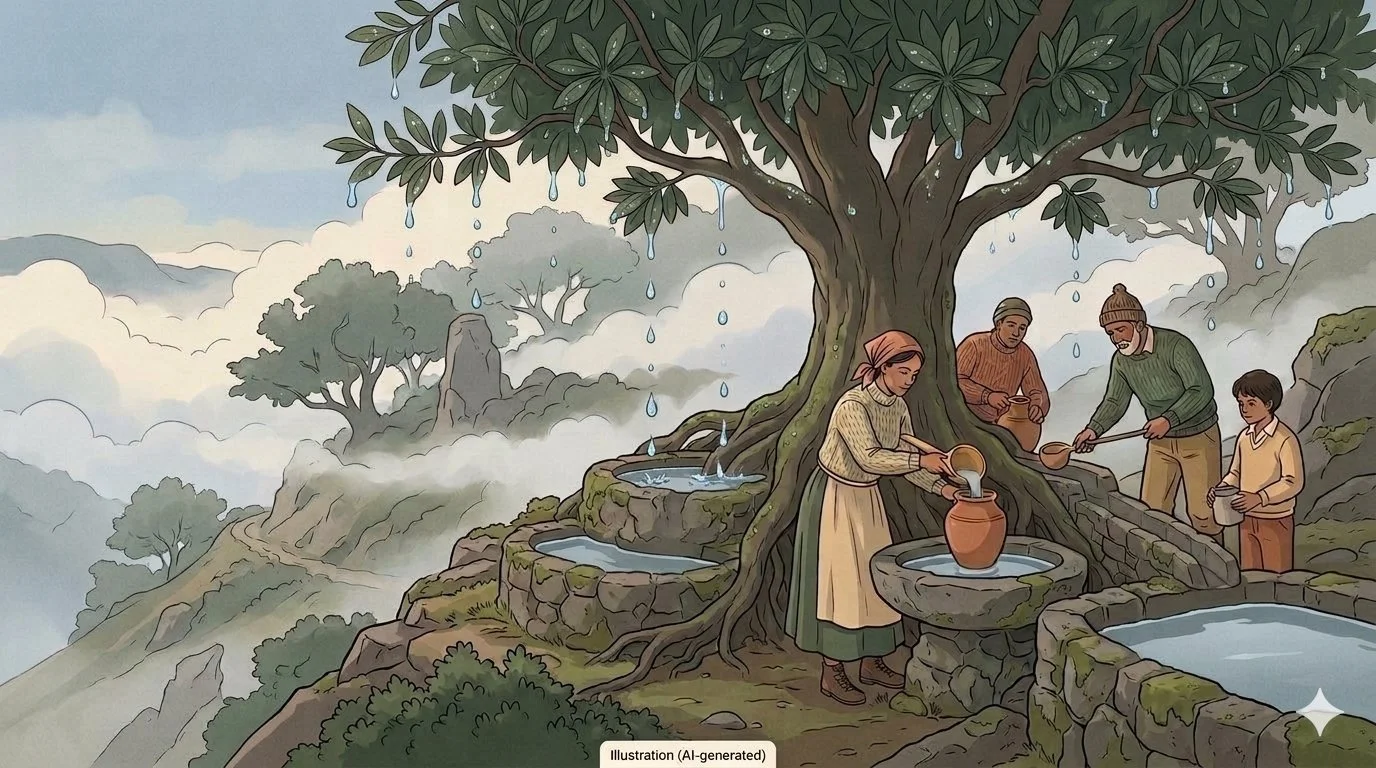
Before there was a net, there was a tree. On El Hierro, the smallest of the Canary Islands, a single great laurel — most likely a til (Ocotea foetens) — grew on a high ridge where ocean fog drifted in almost every day. The island had no rivers and no dependable springs. What it had was that tree: its broad leaves combed water out of the passing fog, and the drops ran down into stone hollows carved at its roots. The islanders called it the Garoé, the holy tree, and for centuries they drank from it. A storm tore the original from the ground in 1610; in 1949 a new til was planted where it had stood, and it stands there still.
Centuries later, on the dry coast of northern Chile, rain almost never falls — but fog rolls in off the Pacific most mornings. Researchers hung large mesh nets across a ridge above the village of Chungungo. As the fog passed through, droplets caught on the threads, gathered, joined, and ran down into a gutter. By 1992 the village had running drinking water for the first time.
A tree does with its leaves what a net does with its threads. The water had always been there. Floating in the air. Invisible, and just out of reach.
What was missing was not the water. It was the net.
UnaMente is a net for knowledge.
Good solutions to hard local problems already exist. Clean water. Healthier soil. Less smoke. Safer food. But that knowledge drifts like fog. It sits in distant villages, in old research papers, in languages most people do not read, and in the memory of people nobody thought to ask. It is there. It is just out of reach.
So the next person to face the problem starts from nothing. They spend months, sometimes years, finding out what someone already knew.
We gather the fog. We find these solutions, we check them against real sources, and we give them away free.
The people behind it
UnaMente was founded and is led by Daniela Young.
In her own words:
The idea started turning in my mind when I saw the DARPA challenge. That was the first gear. Then I saw the fog nets in Chile, and another gear started to turn. Then I saw other solutions, and more gears came together.
They stayed in my head for more than twenty years. I could see what it should be. I could not build it — the research alone would have taken me years I did not have.
What changed was AI. Not using it to write things for me, but training it to do the work properly: to read a paper all the way through instead of skimming it, to check every statement against its source, and to check each other. What would have taken me years of research took months of training and double-checking.
We are small, and we are deliberate. Every innovation is checked before we publish it. We would rather have a small library you can trust completely than a large one with soft spots. The trust is the point.
The library is small today, and it will not stay that way. We are opening with five solutions. Several more are already written and going through checking. Others are still being researched. We will also take submissions — if your community has solved something, we want to document it. What we will not do is publish it faster than we can check it. Everything goes through the same verification, whoever it comes from.
Why we tell you what fails
Most places that share ideas tell you only the success stories. We think that is the more dangerous half of the truth.
The fog nets above Chungungo ran for about a decade. Then they were abandoned — and the reason is worth knowing. The technology worked. The village grew. What failed was everything around it. The local authority stopped maintaining the system and pushed for a conventional pipeline instead. And nobody had ever really handed ownership to the community, or planned for who would pay for repairs.
A working technology is not enough on its own. That is a hard lesson, and it was already paid for. The next community should not have to pay it again.
So every solution here tells you honestly when, where, and why it fails. Not as fine print at the bottom. Often it is the most valuable thing on the page.
What we have learned so far
We have researched enough innovations now to see a pattern.
They start in different places. Some came from researchers. Some came from a business. Most came from a village, a farmer, or a group of neighbours facing a problem nobody else was going to solve for them. Where an innovation started matters less than what happened next — whether a community took it up and made it their own.
That is also where they fail — Chungungo being the clearest case, and far from the only one. We have seen that same shape again and again: the method works, and the ownership does not.
So we pay attention to two things. Whether a solution answers a problem people actually have, rather than one someone assumed they had. And how much work it truly asks of a person — the hours, the digging, the carrying, the daily upkeep. We never call that work free just because no money changes hands.
People will work extraordinarily hard to improve their own lives. That effort deserves to be counted honestly. And it deserves solutions that are worth it.
Nobody has to be a lone genius
Almost nothing is invented alone. Most innovators took something that already existed and adapted it, scaled it, or simply had the courage to act on it. That is more remarkable, not less.
UnaMente takes away the pressure to be the lone genius. When we are open about how much knowledge is shared, borrowed, and inherited, people are free to take real pride in the part that is genuinely theirs.
We stand on each other’s shoulders. That is not a weakness to hide. It is the whole point.
What we are
UnaMente is a Washington State nonprofit and a knowledge commons. It is free to use. No paywalls, no logins, no permission needed. We hold no patents and lock nothing away. Everything contributed to our library stays free for everyone, permanently.
The questions we could not answer
Checking these solutions taught us something we did not expect. Over and over, we found a technique that was only documented in one part of the world — and no good reason why.
Sometimes there is a real reason. A method may depend on a particular climate, a particular soil, or an insect that lives in one region and nowhere else. That is a genuine limit, and we write it into the solution as a limit.
But often the boundary is not real. It is simply where the research stopped. A technique proven in one country has never been tested two countries over, not because it would fail there, but because nobody has tried. The limit is in our knowledge, not in the method.
We also keep finding solutions that could be better. A cheaper material that nobody has tested. A step that could be simplified. A build guide that ought to exist and does not.
So we started writing those down. We call it Calling All Minds — the open questions we found while doing this work, and cannot answer ourselves.
They are real questions with real answers waiting. Does this water treatment work with a plant that grows locally, instead of the one the original research used? Would this soil method work in a different rainfall band? A student, a researcher, or a farmer with a season to spare could settle any one of them — and a whole region might gain a solution it did not have.
Where this is going
Right now UnaMente is a library. You can search it, read it, and use what you find.
But a library only answers questions someone already thought to ask.
The DARPA challenge worked because one problem was put in front of the whole world. We want that to be possible for anyone. No race, and no prize. Just a place where a community can describe a problem they have not been able to solve, and where people anywhere can bring what they know.
Some of those answers already exist somewhere, in a form nobody has connected to the problem yet. Others do not exist yet, and someone will have to build them.
We are not there today. The library comes first, because a place worth gathering around has to be trustworthy before it is worth gathering around. But that is the direction, and it is why we are building it this way.
Minds everywhere, solutions for everyone.